

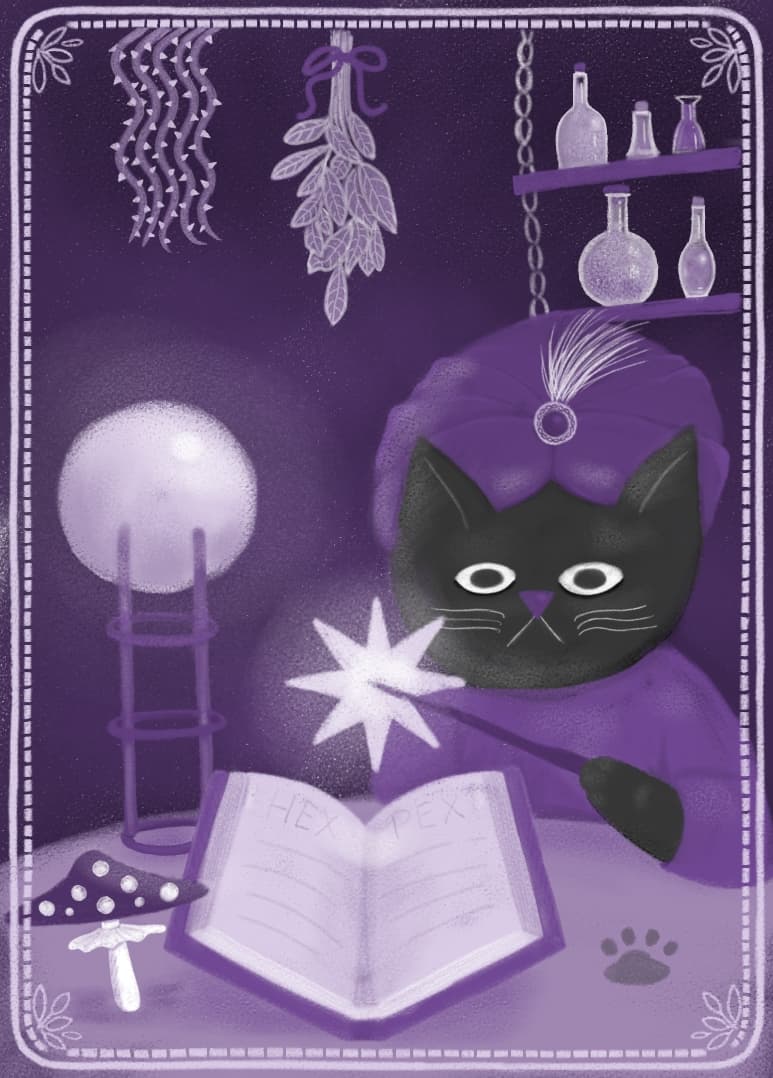

What Lies Beyond the Picture: Five Ways to Read a Metaphorical Card

A metaphorical card usually shows only one moment. For example, a cat stands in front of a door, a person looks out at the sea, a staircase disappears into the clouds, a boat passes a dark shoreline. We can see the scene, but we know almost nothing about it. Who are these characters? How did they get here? Why did they stop at this exact moment? What is nearby but remains outside the frame?
That is what makes these images so interesting. They resemble a page torn from a story rather than a complete narrative. The picture provides a few details, while everything else is left for us to imagine. There is no need to search for a hidden correct meaning or immediately explain the image through your own life. Sometimes it is enough to treat it as the beginning of a small story.
Here are five ways to do that.
1. Imagine what happened one minute earlier
Look at the card and mentally rewind the scene. What was the character doing before this moment? Have they only just arrived, or are they about to leave? Did someone call them? Did they find something, lose something or notice it by accident?
If the card shows a cat beside a closed door, perhaps it heard a sound behind it a minute ago. Or perhaps the cat closed the door itself and is now trying to remember why it came there. Even a small shift in time turns a still image into an action.
Ask yourself: what has changed in the scene during the last minute?
The explanation does not have to be realistic. The stranger the first idea, the more interesting the story may become.
2. Decide what the character is hiding
The person or creature in the picture may have a secret that the viewer does not know. Perhaps something is hidden in a pocket. The character may know the real reason for what is happening, pretend to be calm, wait for someone who is not supposed to arrive or conceal something completely unimportant but amusing.
A secret does not have to be dramatic. A little cat on a rooftop may be hiding the fact that it is afraid to climb down. A traveller with an enormous suitcase may have packed only one pie. A wizard may have forgotten the spell they need.
Try completing the sentence:
Nobody in this picture knows that…
This gives the character an inner world and adds a second layer to the scene.
3. Look beyond the frame
Every picture has edges. The artist shows only part of the space, but the world of the scene seems to continue outside it. What is located to the right, left, above or behind the viewer? Who is watching the character? Where does the road lead? What is reflected in the window but remains invisible? Sometimes one imagined detail changes the entire meaning of the picture.
The cat may not be looking at an empty street, but at a huge parade that did not fit inside the card. Behind the peaceful sea there may be a noisy city. Behind the door may be not a secret room, but an ordinary kitchen where someone has dropped a spoon. Mentally expand the image until it is twice as wide.
What is the first thing that appears beyond its edges?
This approach works especially well with pictures in which the character is looking to one side or a path disappears at the edge of the frame.
4. Imagine what happens next
Now move forward in time. What will happen in a minute? What about in an hour? Will the character take a step, change their mind, meet someone or discover that they misunderstood everything? You can invent several continuations:
- the most likely one;
- the strangest one;
- the funniest one;
- the cosiest one;
- the one that completely changes the genre.
A boat beside a dark island may reach the shore. It may sail past. It may turn out to be a toy floating in an enormous bathtub. The island may actually be the back of a sleeping whale.
A metaphorical card does not have to remain serious. It can become a fairy tale, a mystery, a comedy, a travel story or a few lines of absurd fantasy. The question is simple:
What event would make the picture come alive?
5. Give the story a title
A title helps reveal which version of the scene you have already begun to create. The same picture can be named in entirely different ways:
“The Last Door”, “The Cat Who Forgot Its Keys Again”, “Before the Rain Arrives”, “A Place Where No Guests Are Expected”, “Three Minutes Before the Miracle”
The first title may make the scene feel unsettling, the second makes it comic and the third makes it peaceful. The picture has not changed, but the story already has.
Try inventing three titles: a serious one, a fairy-tale one and a ridiculous one. One of them will usually suit the picture unexpectedly well.
Build a story instead of searching for an answer
You can use these five approaches separately or combine them into one short story:
A minute ago, the character heard a sound. They are hiding a letter. Someone is approaching beyond the frame. In another minute, the door will open. The story is called “The Message That Arrived a Hundred Years Late”.
It does not matter whether this version matches the artist’s original intention. A metaphorical card is interesting precisely because the picture does not end with what has already been drawn. Another person may see a completely different story in the same scene. You may return to the card a week later and imagine a new continuation yourself. Sometimes we notice the character. Sometimes the background. Sometimes we are interested not in what is happening, but in what is clearly missing.
A small game with one card
Choose a card and do not rush to read someone else’s interpretation. Look at it as though it were a frame from an unknown film.
Answer five questions:
- What happened one minute earlier?
- What is the character hiding?
- What lies beyond the picture?
- What happens next?
- What is this story called?
Your answers can be only one sentence long. You can write them down, say them aloud or simply imagine them. And if the first story feels too obvious, invent a second one with a completely different mood.
Let the same forest first become a place of escape and then a picnic spot. Let the mysterious silhouette turn out to be not a ghost, but a neighbour searching for a lost hat.
Choose a metaphorical cardA metaphorical card does not have to explain you, offer advice or lead to an important conclusion. Sometimes it can simply be a doorway into a story that did not exist a few seconds ago.