

A Bird in the Cup: Why This Symbol Is Associated with Messages and Journeys
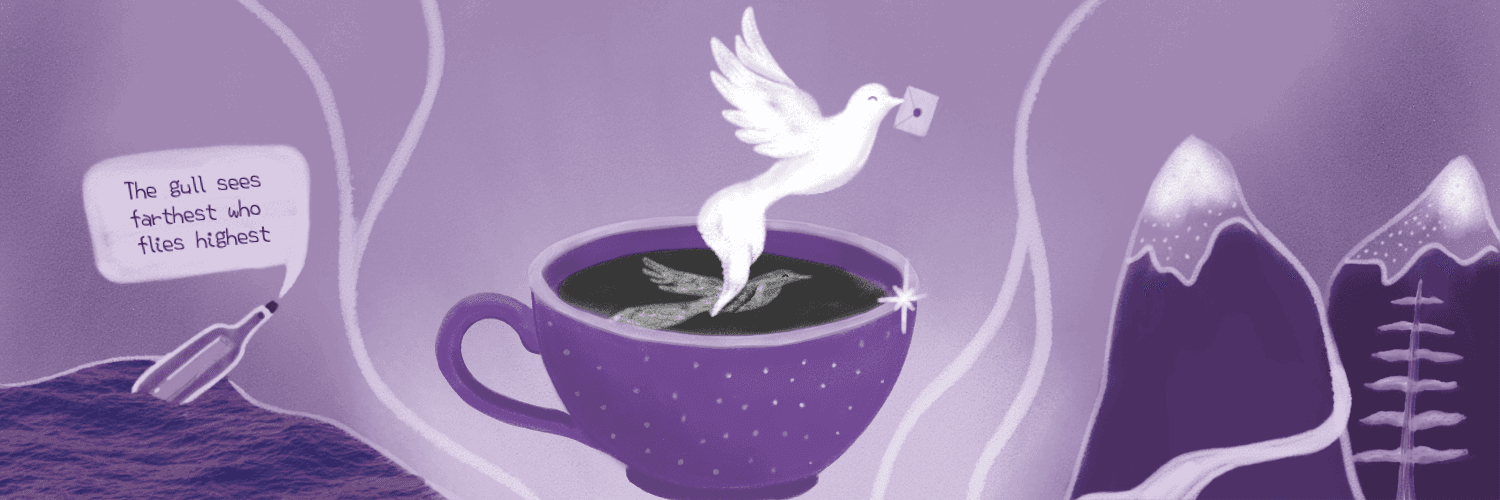
In the patterns left by coffee grounds, you can see almost anything: a tree, a face, a boat, a mountain or a creature that appears in no guidebook. Yet birds appear especially often in symbolic interpretations. A few branching lines become wings, a small projection turns into a beak, and a dark patch suddenly resembles a figure in flight.
In both old and modern guides to tea-leaf and coffee-ground reading, birds are often associated with journeys, news or messages. However, there has never been a single universal dictionary: the meaning changes depending on the tradition, the species of bird, its position and, of course, what the viewer actually sees. In one guide, a bird promises a pleasant journey; in another, a flying bird becomes an image of approaching news.
Where did this connection come from?
A bird that knows more than people do
Long before coffee cups existed, people observed birds and tried to find meaning in their behaviour. Birds arrived from far away, disappeared beyond the horizon and returned from places people could not see. It was therefore easy to imagine them as creatures carrying news from somewhere else.
In the ancient Greek and Etruscan worlds, the flight, direction and calls of birds could be interpreted as signs. This did not necessarily mean that the bird itself “knew the future”. Rather, people believed that the intentions of the gods could be revealed through its appearance or behaviour. The bird’s species, the part of the sky in which it appeared, the time and the direction of its movement could all matter.1
Birds play a similar role in Northern European mythology. Odin’s two ravens, Huginn and Muninn, flew around the world every day and returned with information about what was happening. Their names are commonly associated with thought and memory, while the National Museum of Denmark describes them as sources of knowledge for Odin.2
A bird makes a convenient messenger: it does not need roads, gates or permission to cross a border. It appears from above, arrives from far away and seems to connect two points separated by a long journey for humans. Perhaps this is why the image of a bird so easily became a sign of news: someone or something is already in motion and may soon arrive.
A road that cannot be seen on a map
A bird is associated not only with a message, but with the journey itself. Unlike a ship or footprints on the ground, its entire route cannot be seen. There is a point from which it took off and a direction in which it disappeared, while everything between them is left to the imagination.
A bird in the cup may therefore bring to mind:
- a journey;
- a return;
- a change of place;
- the arrival of someone from far away;
- an unexpected change of route;
- the desire to spend some time somewhere else.
In one widely circulated English-language guide to tasseography, a bird is directly interpreted as an approaching pleasant and fortunate journey. But this is only one traditional interpretation, not a universal rule.
Even the bird’s position changes the story. A sitting bird appears to be waiting for something. One with open wings is ready to depart. A flock moves differently from a solitary figure. A shape resembling a chick inspires very different associations from a large raven or a bird of prey.
Between earth and sky
Birds live near people, walk on the ground and build nests, yet they can rise into the air at any moment. Because of this ability, they became symbols of transition between different states or worlds in many works of art and religious traditions.
In Ancient Egypt, one aspect of the human personality — the ba — could be represented as a bird with a human head, or as a special bird capable of leaving the tomb. Museum descriptions refer to the ba as a part of the person that continued to exist after death.3
In medieval European art, a small bird beside the infant Christ could sometimes symbolise the human soul and resurrection. The white dove became a recognisable representation of the Holy Spirit in Christian iconography.
In Farid al-Din Attar’s Persian poem The Conference of the Birds, a flock sets out in search of the mythical Simurgh. In this allegory, the birds represent souls undertaking a difficult journey towards spiritual unity.4
This does not mean that a bird always represents the soul in every culture. Rather, its ability to move between earth and sky repeatedly made it a fitting image for something that cannot remain in one place.
But what kind of bird is it?
The word “bird” conceals hundreds of very different images. A dove, raven, crane, owl and sparrow may carry completely different or even opposing meanings. Sometimes the specific species, its behaviour and its place in local culture matter more than the simple presence of wings. For example:
- the dove is associated with the Holy Spirit in Christian art;
- Odin’s ravens bring knowledge of the world;
- the crane is often connected with longevity and immortal beings in East Asian art;
- the ancient Egyptian Bennu bird was associated with creation and renewal, and was later compared by the Greeks with the phoenix.
This is why the statement “a bird means good news” is too simple. What kind of bird is it? Is it arriving or leaving? Is it sitting quietly or opening its wings? Does it appear friendly, anxious, noisy or alone? The symbol begins to change even before we consult a dictionary.
The bird in the coffee grounds
In traditional tasseography, the position of a figure inside the cup could also influence its interpretation. Different schools divided the cup into areas associated with the past and future, near and distant events, or positive and negative influences. There was no single system. Methods of reading were largely passed down through practice and oral tradition, and they varied considerably.
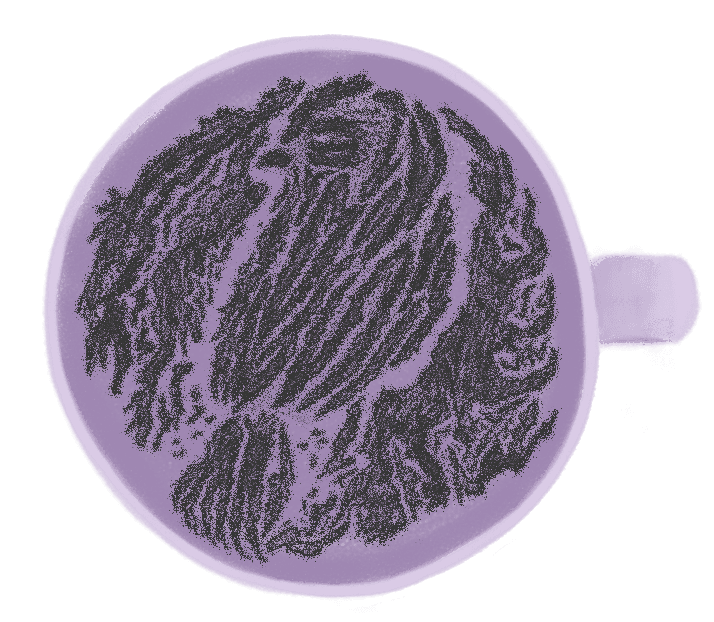
Meowracle suggests considering the image of a bird as the beginning of a short story:
- whether it is flying or sitting;
- whether it is moving towards the rim or the centre of the cup;
- whether it is alone or surrounded by other shapes;
- whether it resembles a particular species or only a general silhouette;
- whether it seems like a messenger, traveller, observer or an ordinary city pigeon.
Sometimes the first association is traditional: a letter, news, a journey. At other times, something entirely personal appears — a trip to the sea, a familiar crow on the balcony, the calls of seagulls or a bird from an old fairy tale.
One interpretation does not cancel another. The symbol remains recognisable precisely because it can carry many stories — much as a bird itself travels from one place to another.
SEE WHAT IS HIDING IN THE CUPNot a prediction, but the beginning of a story
The bird in the cup does not know whether a letter will arrive tomorrow or whether a journey will take place. It has no access to calendars, tickets or other people’s decisions. Yet for centuries, this image has accompanied stories about messages, roads, souls, knowledge and transitions. That is why even a random patch can so easily awaken a familiar thought: something is in motion. It may be news, it may be a journey, or it may simply be a bird that appeared on the side of the cup for a few seconds before the coffee grounds became a collection of dark lines again.
Sources and Further Reading
- Birds as signs in ancient Greek and Etruscan traditions: Ancient Greek Religion and Etruscan Religion, World History Encyclopedia.
- Odin’s ravens as sources of information about the world: The Viking Gods, National Museum of Denmark.
- The ba represented as a bird in Ancient Egyptian art: Scarab with Ba Bird and Nefer, The Metropolitan Museum of Art.
- Birds as souls in The Conference of the Birds: The Concourse of the Birds, The Metropolitan Museum of Art.
- Traditional interpretations of figures in tasseography: Tea Leaf Reading (Tasseography), Encyclopedia.com.