Cross in Coffee Grounds: What This Symbol May Mean
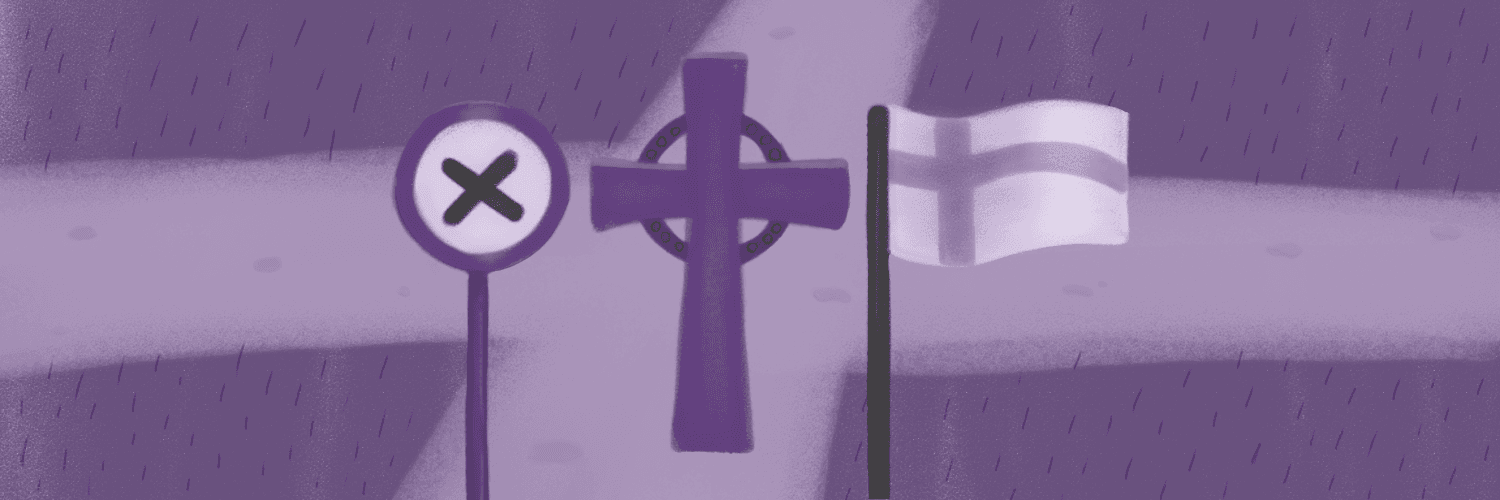
The cross is one of those shapes that is easy to notice even among random stains. Two intersecting lines are enough for the eye to immediately turn them into a familiar sign. In coffee grounds, it may appear almost perfect, as if it had been drawn, or only as a suggestion: one dark streak crosses another, spots remain nearby, and the image becomes visible only from a certain angle.
But the cross is too ancient and too full of meanings to have one universal interpretation. It may suggest a choice, a challenge, a crossroads, protection, faith, or the point where two directions unexpectedly meet. So before looking for a ready-made meaning, it is interesting to notice what kind of cross has appeared in the cup.
Not Only a Religious Symbol
Today, the cross is primarily associated with Christianity, but the form of intersecting lines existed in symbolism long before the emergence of any one particular religion. It is a very simple geometric figure: a vertical line meets a horizontal one, the space is divided into four parts, and a point of intersection appears in the centre. It is precisely this structure that makes the cross a convenient symbol for many different stories.
It may suggest:
- the meeting of two paths;
- a boundary;
- a choice of direction;
- a centre around which everything is arranged;
- the union of opposites;
- an obstacle that cannot simply be avoided.
So a cross in coffee grounds does not necessarily have to be interpreted immediately as a religious sign. Sometimes it looks more like a crossroads or a mark on a map.
An Intersection as a Moment of Choice
If we look at the cross as two roads, the image of a crossroads appears. One line continues forward, while the other unexpectedly offers a turn. In such a pattern, the cross may suggest a situation in which the familiar direction is no longer the only one.
It becomes especially interesting when other figures appear nearby. A cross beside a road strengthens the feeling of choice. Next to a key, it may suggest a decision that opens a new path. Near a house, it may resemble the boundary between familiar space and something outside it.
However, this symbol does not tell us which direction is “right.” Rather, it makes the very fact of intersection noticeable. Sometimes the question suggested by such a cup can be simple:
What interests have come into conflict along my path?
The Cross as a Stop or an Obstacle
The same figure can be perceived in a completely different way. If the cross looks heavy, dark, and blocks a long line, it may resemble an obstacle. Movement seems to run into the sign: it is no longer possible to continue in the same way. This does not necessarily mean something bad. Sometimes an obstacle forces us to stop, look around, or choose another route.
In a symbolic story, it is important to pay attention to scale. A small cross near the rim of the cup looks like a brief interruption or a mark. A large one, taking up almost the entire surface, becomes the central event of the image. And if the line continues after the intersection, the story changes once again: the obstacle turns out not to be the end of the road, but part of the journey.
Four Sides and a Central Point
The cross divides space into four directions. Because of this, it can resemble a compass or a map. In a cup, such an image sometimes feels less like a separate object and more like a centre from which possible paths spread outward.
- What is above it?
- What remains below?
- Which figures are located to the right and left?
- Is there one side that looks more open?
Sometimes the meaning appears not in the cross itself, but in what has gathered around it.
For example, there may be a dense dark patch on one side and an almost empty space on the other. Then the image begins to resemble a choice between the known and the uncertain. If two figures are nearby, the cross may become the point where they meet or, on the contrary, where they separate.
What Is Traditionally Associated with a Cross in Coffee Grounds
In traditional interpretations, the cross is often considered a serious symbol. It is associated with a challenge, responsibility, an important decision, or a situation that requires attention. Sometimes the meaning depends on its position: a sign closer to the rim of the cup may be interpreted as a nearer event, while one close to the bottom may represent something distant or deeply hidden.
But these meanings differ from one system of reading to another, so they should not be treated as a universal dictionary. It is much more interesting to combine the traditional association with the way your particular pattern looks.
- Is the cross surrounded by light space or almost hidden in the grounds?
- Does it stand alone or connect with a road?
- Is there a person, bird, house, or key nearby?
- Does it look like a prohibition or, on the contrary, a signpost?
The same sign can tell completely different stories in different cups.
The Cross as a Point of Intersection
Perhaps the most interesting thing about this symbol is not to search for a predetermined warning in it. A cross appears where one line meets another. It may be a place of choice, an obstacle, a meeting, a centre, or simply a random pattern that the brain has turned into a familiar shape. In coffee grounds, it can become the beginning of questions:
- What is intersecting in my life right now?
- Is there a decision I keep postponing?
- Which path continues from here?
- What looks like an obstacle only because I am viewing it from one angle?
Sometimes it is enough to turn the cup, and the symbol is already telling a different story.
SEE WHAT IS HIDING IN THE CUP