
The Moon and Crescent as Symbols: Cycles, Light, and Change
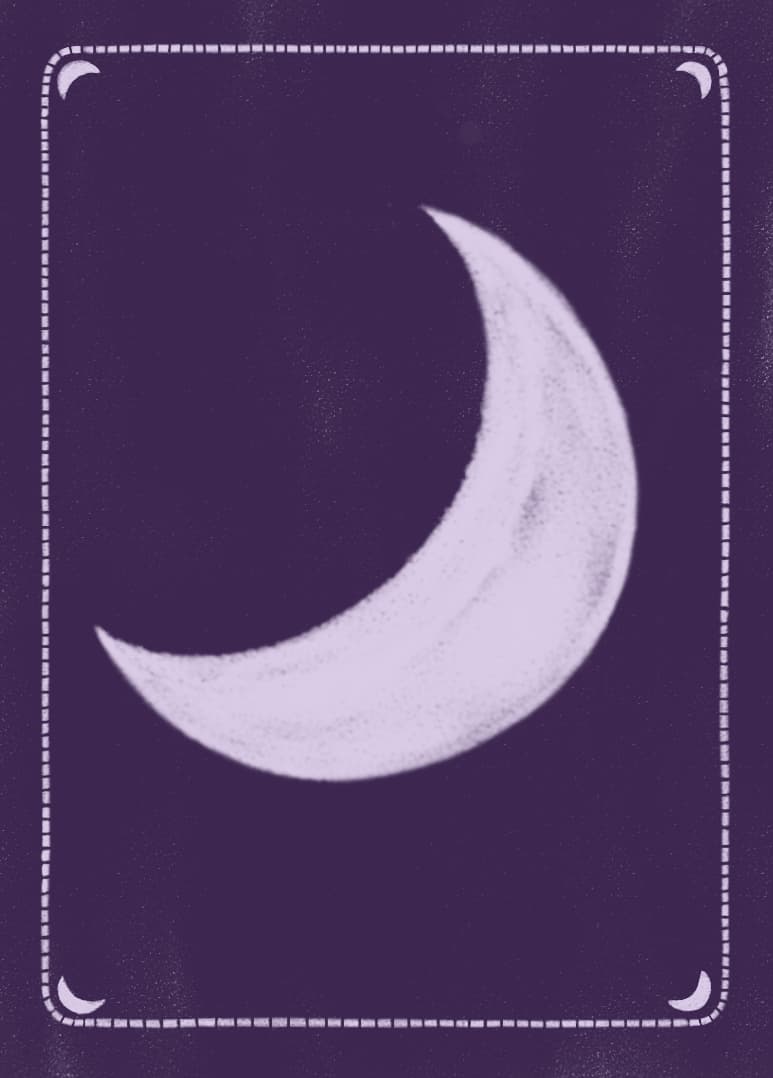
Have you noticed how different the moon looks each day? Today it is almost round; a few days later it becomes a slender crescent, then disappears and returns again. Perhaps that is why this symbol so readily suggests change, time, and shifting states. On a metaphorical card, the moon may be enormous and fill half the sky, appear as a tiny dot above a city, be reflected in water, or take the shape of a thin crescent. And each time, the story changes depending on the moon we see and what is happening around it.
Light That Appears in the Dark
Since moonlight is reflected sunlight and the moon produces no light of its own, it remains part of the night, making its surroundings only a little easier to distinguish. Moonlight may therefore bring to mind a situation in which we cannot see everything at once, but can already make out a direction, the outline of a road, or nearby objects: not complete clarity, but a small point of guidance. In a symbolic image, it can be interesting to look at the following:
- What is the moon illuminating?
- What remains in shadow?
- Is there enough light to keep moving?
- Do we need to see the entire path at all?
Sometimes a little light is enough to take the next step.
The Crescent as Something Incomplete
We can imagine a crescent as something incomplete: we know the circle exists, even though we can only see part of it at this moment. This image may therefore suggest a process that is not yet finished: something has already appeared, but has not yet become whole. Or, conversely, something is gradually diminishing and drawing to a close.
A slender waxing crescent may be associated with a beginning, the first sign of change, or an idea that is only starting to take shape, while a waning crescent may suggest gradually letting go, bringing something to a close, or reducing something that once took up more space. A single image does not always tell us whether the moon is waxing or waning. At such moments, what matters is not the astronomical meaning but our personal impression: does this crescent feel like a beginning or the remains of something?
Repeating Cycles
The lunar phases continually follow one another: the full moon gradually disappears, and then a new lunar cycle begins with the new moon. In this way, the moon can become a symbol of repetition that contains change: a situation returns, but the person encountering it is already a little different. We might ask:
- What keeps repeating in my life?
- Does this return resemble the past, or is something different this time?
- What stage has this cycle reached now?
- Would it be better to wait for the next phase instead of trying to hold on to the current one?
The Moment of Greatest Visibility
The full moon looks whole, and as a symbol it may recall a moment when something significant has happened. What once existed only as a small crescent now fills the entire space: an idea has taken shape, a feeling has become impossible to ignore, or a situation has reached a particular point.
Yet the full moon is a culmination rather than an ending: after it, the moon begins to wane. The complete circle can therefore suggest both a sense of wholeness and the fact that the present state will not remain unchanged. Think about what has now reached its full form. What has become more noticeable than before? Do you need to hold on to this moment, or allow it to change?
In illustrations, the moon often hangs high above a character. It does not act directly, but is present in the scene and seems to watch what is happening. If the moon has a face or an eye, this impression becomes stronger. It may then become a witness, a keeper of secrets, or an image of something that sees the situation from another point of view.
- Is the character looking at the moon?
- Is it behind them?
- Does the moonlight guide them, or simply accompany them?
- Is there any interaction between them?
Sometimes the moon does not explain the story, but creates the feeling that what is happening has another silent witness.
The moon in water usually carries a double symbolism. There is the real object in the sky and its reflection, which depends on the surface. Still water creates an almost perfect copy, while waves stretch it, break it up, and turn it into patches of light. Someone looking only downwards may see the moon without even raising their head. Such an image readily suggests perception.
What am I seeing: the object itself or its reflection?
How much is the surface distorting the image?
Has what I am looking at changed, or only the conditions in which I see it?
Sometimes the same light looks completely different depending on where it is reflected.
What the Moon and Crescent Mean in Coffee Grounds Reading
In traditional interpretations of coffee grounds, the moon is associated with emotions, intuition, change, mystery, and events that unfold gradually. A crescent is sometimes interpreted as the beginning of a new period or a sign of a process that has not yet reached its full form. Yet in a chance pattern, a thin crescent can be mistaken for a boat, a horn, a smile, or the edge of a circle. A full moon may resemble a coin, a ring, the sun, or an eye. So it is worth looking at the image first:
- Is the moon full, or is only part of it visible?
- Are there stars, water, a road, or a figure nearby?
- Does it look bright, or does it almost disappear among the other marks?
- Is there another circle or a reflection nearby?
Only then might you ask yourself:
- What is changing at the moment?
- What can I still see only in part?
- Which cycle is drawing to a close?
- What might become more noticeable a little later?
The Moon as a Symbol of Change
Perhaps the moon's most important quality as a symbol is its ability to change while remaining itself. A slender crescent, a half-circle, and a full moon seem like different images, although they belong to the same object. The moon may therefore remind us that a change of form does not always mean a loss of essence. Sometimes we see only part of what is happening; sometimes everything becomes as clear as it can be; and sometimes a familiar shape almost completely disappears from view. But that does not mean it has disappeared forever.
SEE WHAT IS HIDING IN THE CUP