

Coffee Grounds and Tea Leaves: How Two Cup-Reading Traditions Differ
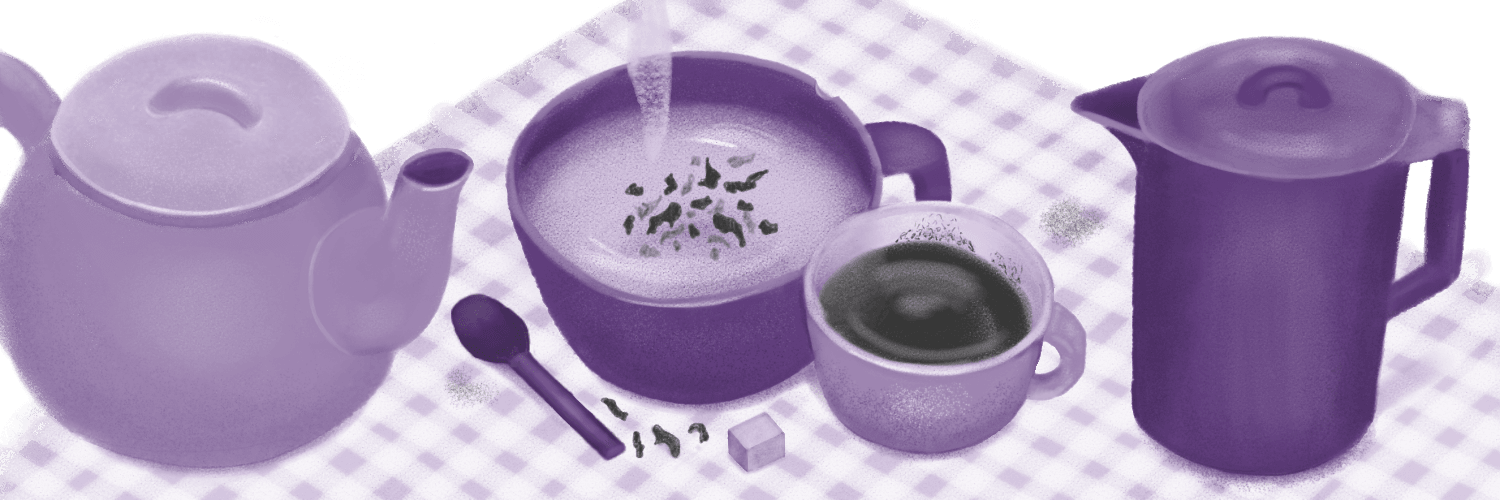
After a drink, what remains at the bottom of a cup is sometimes more than simple residue: it can look like a tiny landscape. Coffee grounds spread across the walls in dark lines, while tea leaves gather into separate dots, figures, and little islands. A bird, a tree, a road, a face, or something difficult to name at first may appear among them.
Both practices are commonly described by the word tasseography - the reading of patterns left in a cup after tea or coffee. However, tea leaves and coffee grounds create different kinds of images, and different customs and rituals have developed around them.
So how do these two traditions differ?
One Cup - Two Different Materials
The main difference appears before the interpretation even begins. Tea-leaf reading uses loose-leaf tea, whose small particles remain in the cup after the drink is finished. They may lie separately, gather into groups, or form a chain along the wall.
Coffee grounds behave differently. This kind of reading requires very finely ground, unfiltered coffee - especially coffee prepared in the Turkish style or by a similar method, which leaves a thick sediment in the cup.
This is why a tea pattern often resembles a scattering of signs, while a coffee pattern looks more like a dark map made of lines, stains, and transitions. In a teacup, several small figures may appear at a distance from one another. In a coffee cup, one large streak may become a river, a bird's wing, or a human silhouette all at once.
Read also: First, Drink the Coffee: How to Turn Coffee-Ground Reading into a Pleasant Ritual
Tea Leaves Usually Remain Inside the Cup
In tea-leaf reading, the person drinks the tea, leaving a little liquid and the leaves behind. The cup is then usually turned carefully so that the particles spread across the walls, after which the resulting shapes are examined. There is no single exact ritual: the methods were passed down as a practical tradition and could differ from one family to another or from one guidebook to the next. The Horniman Museum notes that the origins of tea-leaf reading cannot be established with certainty, but that the practice became popular in Europe after Chinese tea spread there in the seventeenth century.1
Tea leaves usually do not create a continuous surface. The reader seems to connect separate points: here is a bird, beside it something resembling a letter, and below it a path made of small leaves. It is a little like looking for constellations: the elements already exist, but the connections between them are created by the imagination.
The Coffee Cup Is Usually Turned Upside Down
In the coffee-ground tradition, the cup is often covered with a saucer after the drink, turned upside down, and left for a while. As it stands inverted, the wet sediment slowly moves along the walls and creates new streaks. When the cup is lifted, the pattern is already noticeably different from the one that appeared immediately after the final sip. The grounds leave dense dark areas, thin lines, clear spaces, and sometimes almost complete silhouettes.
The saucer may also become part of the reading: drops and traces that have flowed out of the cup remain on it. The rules differ here as well. In some traditions, the saucer is read separately, while in others only the pattern inside the cup is considered important.
Turning the cup upside down adds a sense of anticipation. The image develops for a while without human involvement - almost like a photograph slowly appearing.
Different Geographies of the Traditions
Tea-leaf reading became especially closely associated with European ideas of domestic tea drinking. In Britain and other European countries, it became known as an activity that could take place at an ordinary table, in a sitting room, or during a friendly gathering. Special cups marked with symbols and divided into sections were even produced for it.
The coffee tradition is closely connected with regions where finely ground, unfiltered coffee is common: Turkey, the Balkans, the Caucasus, and various parts of the Middle East. Turkish coffee is not only a drink but also a social ritual associated with hospitality, conversation, and spending time together. In 2013, Turkish coffee culture and tradition were added to UNESCO's Representative List of the Intangible Cultural Heritage of Humanity.2
However, it is impossible to draw a strict boundary between the two traditions. Ways of preparing drinks travelled with people, while reading methods mixed and changed. Tasseography was never a system created by a single author with one officially approved set of rules.
The Same Symbols Look Different
Similar images can appear in both tea leaves and coffee grounds:
- a tree;
- a key;
- a ring;
- a road;
- a ship;
- a heart;
- a bird;
- a letter or number.
But the material changes the character of the symbol. A tea-leaf bird may consist of three separate leaves: two resemble wings and one resembles the body. A coffee-ground bird is more likely to appear as a solid stain or a long flying silhouette. A road in a teacup may look like a chain of particles. In a coffee cup, it may appear as a light passage between two dark areas.
This is why even familiar meanings do not decide everything in advance. First, the person must notice the figure, understand where it begins and ends, and decide what exactly it resembles.
The Meaning of the Rim and the Bottom Depends on the System
In many styles of reading, the position of a sign is connected with time or with how near an event may be. A figure near the rim may represent something close, while one at the bottom may suggest something distant or deeply hidden. Sometimes the cup is divided in relation to the handle, which is treated as the point connected with the person who drank from it.
However, this is not a universal language. Another guide may interpret the same areas differently. Two readers may therefore see the same bird and not only give it different meanings, but also explain its position in different ways. One may focus on its distance from the rim, another on the direction of its flight, and a third on the neighbouring figure. Here, a traditional symbol dictionary offers a possible story rather than a final translation.
What Tea and Coffee Have in Common
Despite their differences, both practices begin with the same moment: an ordinary trace left by a drink becomes an image. A person first sees a random shape, then recognises a familiar object within it, and finally connects it with a story. A stain becomes a bird, and the bird becomes news, a road, or a memory of seagulls by the sea.
There is no need to believe that the cup predicts the future. It can work as a visual puzzle and a reason to begin a conversation.
Read also: A Bird in the Cup: Why This Symbol Is Associated with News and a Journey
Which Cup Should You Choose?
The choice does not depend on which tradition is more "accurate," but on which kinds of images are more interesting to examine.
Tea leaves may suit those who enjoy:
- connecting separate elements;
- searching for small symbols;
- imagining relationships between several figures;
- seeing something like a map or constellation inside the cup.
Coffee grounds may suit those who are more interested in:
- large abstract stains;
- lines and silhouettes;
- turning the cup and changing the angle;
- a pattern that can be perceived as one complete scene.
In Meowracle, the cup of coffee grounds does not offer one correct prediction. It can be turned so that the same trace first resembles a tree, then fire, and later an unfamiliar island.
SEE WHAT IS HIDING IN THE CUPTea leaves and coffee grounds speak different visual languages. The first scatter their clues as separate signs, while the second leave dark roads and stains. Yet both traditions begin in the same way: the drink is finished, the cup is almost empty - and that is precisely when space for a story appears inside it.
Sources and Further Reading
- History and Practice of Tea-Leaf Reading: Tea's Alternative Uses: Reading Tea Leaves, Horniman Museum and Gardens.
- Turkish Coffee, Hospitality, and the Tradition of Reading Coffee Grounds: Turkish Coffee Culture and Tradition, UNESCO.